
Hello, dear students and nature lovers!
This is Mirella and I’m always thrilled when science meets real-life safety lessons. That’s exactly why I’m so excited to share this detailed article with you today. It expands on a fantastic educational reel that was featured on our popular Bioloquizefy Instagram page, which has all the fun facts from our tutors at Tutor Liban! If you haven’t watched it yet, the reel is right here!
In the reel, I shared quick but life-saving warning about wild mushrooms in Arabic. Today, I’m expanding on that message in English with everything you need to know to stay safe.
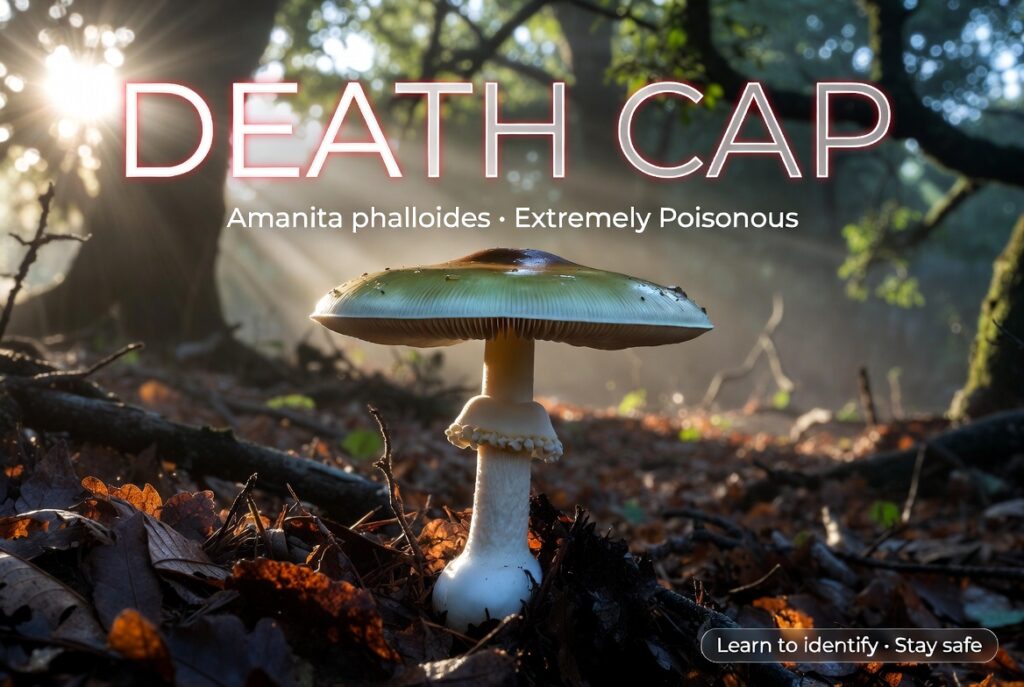
Not all champignons are safe to eat or comestible. Many wild mushrooms deceive us with their beautiful shapes, but in reality they are not good. This is classic fungal mimicry that tricks even experienced foragers. The most dangerous example is Amanita phalloides, known in English as the Death Cap. In French it is called Amanite phalloïde and sometimes Calice de la Mort. From its name alone we know it is one of the deadliest types of champignons.
This mushroom causes 90% to 95% of serious, often fatal, poisoning cases in France and accounts for roughly 90% of all mushroom-related deaths every year worldwide. In 2024 alone, French poison control centers recorded 1,363 wild-mushroom poisoning cases, including three deaths. Similar incidents have been reported right here in Lebanon, especially spring intoxications among foragers mistaking white phalloid-like Amanita species for edibles in oak forests. A single small cap — or even half a cap — contains enough amatoxin to kill a healthy adult. Children, the elderly, and anyone with liver problems are even more vulnerable. Cooking, drying, or freezing does nothing — the toxins are heat-stable.
The three key features make Amanita phalloides easy to recognize once you know what to look for:
- The volva — the white, sack-like cup at the base of the stem that looks like a delicate chalice or heel encasing the swollen bottom. Always dig gently around the base because leaf litter often hides it. No edible button mushroom or field mushroom has this structure.
- The white lamellae (gills) underneath the cap. They are crowded, free, and stay pure white (sometimes with a slight greenish tint near the edge) without touching the stem. Edible champignons like the common button mushroom (Agaricus bisporus) start with pink gills that turn chocolate brown as they mature.
- The cap itself, which can be two colors: greenish-white to olive or even almost pure white. It is usually 5–15 cm wide, starts egg-shaped and flattens with age. The surface is shiny and slightly sticky when wet, often with faint radiating streaks and a darker centre. Older caps can show a darker olive-bronze tone.
Extra identification clues I always share with my students
- A skirt-like white ring (annulus) usually hangs high on the stem, often with faint citrine (yellowish) tinges and longitudinal stripes.
- The stem is white with possible greenish tinges and faint olive scales.
- It grows in mycorrhizal association with oaks (Quercus), beech, chestnut, or hazel — rarely in open fields.
- Smell: almost odourless or faintly pleasant (like roses) when young; becomes urine-like and disagreeable when mature.
- Taste: mildly sweetish (but never test this!).
Young “button” Death Caps are frequently confused with the highly prized edible Caesar’s mushroom (Amanita caesarea), which has a bright orange-red cap, striated margin, and cream-to-yellow gills. Always check the volva and gill colour — the Death Cap has neither the vivid colour nor the striations of Caesar’s mushroom.
Inside the Death Cap are powerful bicyclic octapeptides called amatoxins, mainly α-amanitin. These toxins irreversibly bind to RNA polymerase II, stopping liver and kidney cells from making proteins and causing massive cell death. The scariest part is the delayed symptoms:
- Latent phase (6–24 hours, sometimes up to 48 hours): you feel perfectly fine.
- Gastrointestinal phase (starts 6–12 hours after eating): violent nausea, vomiting, profuse watery diarrhoea, abdominal cramps, and dehydration.
- Apparent recovery phase (24–48 hours): symptoms may ease and you think you’re getting better.
- Liver and kidney failure phase (3–5 days or 48–96 hours): jaundice, rising liver enzymes, coagulopathy, hepatic encephalopathy, and possible multi-organ failure.
Even with modern hospital care, mortality can reach 10–20% in severe cases, though prompt treatment has lowered the overall rate to around 10–15%. In the worst cases, a liver transplant is the only option. Historically, the Death Cap has been linked to the deaths of Roman Emperor Claudius and Holy Roman Emperor Charles VI. Its mild, pleasant taste gives no immediate warning.
Practical safety tips every student and forager should follow
- Never eat any wild mushroom unless you are 100% certain or have checked with a local mycological expert.
- Use the three-feature rule (volva + white gills + greenish-white cap) every single time.
- Take clear photos of the entire mushroom, including the dug-up base, before picking anything.
- Teach your younger siblings, children, and friends — these accidents often involve kids.
- If you suspect poisoning, call emergency services immediately and bring a sample of the mushroom to the hospital. Do not wait for symptoms to worsen.
- In Lebanon and the Mediterranean, be extra careful in oak forests during spring and autumn when these mushrooms fruit.
Beauty in nature can sometimes be deadly. Amanita phalloides — the Death Cap, Calice de la Mort — proves that even the most innocent-looking champignon can hide a lethal chalice. By understanding its volva, white gills, green-white cap, and the full science behind its toxins, you can enjoy safe foraging and appreciate Lebanon’s rich biodiversity without any risk.
At Tutor Liban, my mission is to make learning practical and life-saving. Remember my golden rule: when in doubt, leave it out!
If you have questions about this topic or any other biology lesson, feel free to book a free consultation with me right here. Stay curious, stay safe, and happy learning!
