
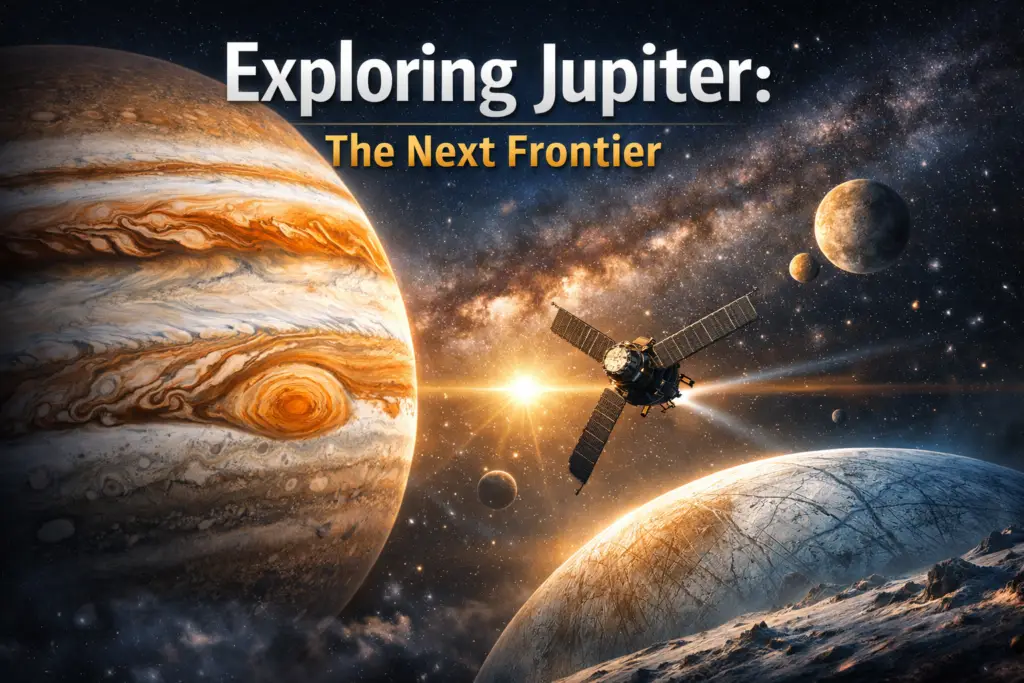
A deep dive into humanity’s most ambitious frontier
The dream of reaching Jupiter has shifted from the realm of science fiction into the blueprint phase of modern astrophysics. As of 2026, the arrival of the Europa Clipper and the JUICE (JUpiter ICy moons Explorer) missions in the early 2030s represents the most sophisticated robotic reconnaissance ever attempted. These missions are the digital precursors to what many hope will be the first crewed expedition to the outer solar system. However, the path to the “King of Planets” is not merely a long flight; it is a battle against the most hostile environment in our neighborhood.
The Siren Call of the Icy Moons
While Jupiter itself is a gas giant with no solid surface to stand on, its moons—specifically Europa, Ganymede, and Callisto—are the true targets for future habitation. Scientists are particularly captivated by Europa, which is believed to harbor a subsurface ocean containing twice the water of all Earth’s oceans combined.
“Europa Clipper will conduct detailed reconnaissance of Jupiter’s moon Europa and investigate whether the icy moon could have conditions suitable for life. The mission will place a spacecraft in orbit around Jupiter in order to perform a detailed investigation of Europa—a world that shows strong evidence for an ocean of liquid water beneath its icy crust.”
Exploration of these moons offers the tantalizing possibility of finding extraterrestrial life, but it also provides a potential source of water and fuel for deep-space outposts. Ganymede, the largest moon in the solar system, even possesses its own magnetic field, which could offer a slight reprieve from the surrounding chaos.
The Invisible Wall: Radiation and Distance
The primary obstacle to human travel is not just the staggering distance—an average of 484 million miles—but the invisible “death zones” created by Jupiter’s massive magnetosphere. Jupiter acts like a natural particle accelerator, whipping charged particles to near-light speeds.
“Jupiter’s magnetic field traps a ton of charged particles, creating deadly radiation belts especially near the orbit of its moon Io. Any human right outside that region, without heavy shielding, would accumulate a lethal dose of radiation in a matter of hours. That’s why probes like Juno need extra-thick protection and carefully timed orbits to dodge the worst of it.”
To survive, a crewed vessel would need shielding far beyond our current capabilities, or a trajectory that skirts the edges of these belts. Furthermore, the transit time using current chemical rockets would take roughly six years. For astronauts, this means half a decade of bone density loss and psychological isolation before even reaching their destination.
From Florida Sands to Jovian Storms
The history of reaching Jupiter is inextricably linked to the Sunshine State. While most of the world looks to Cape Canaveral for the roar of the engines, the connection to the gas giant spans the Florida coastline. Interestingly, while NASA engineers in Jupiter, Florida, work on specialized hardware and support systems, the rockets themselves have historically been born from the “Jupiter” line of missiles.
“The Jupiter-C, which was designed under the direction of German scientist Wernher von Braun, was used in 1956 and 1957 for three unmanned sub-orbital spaceflights. Three Jupiter-C flights were made, followed by three satellite launches (from Juno I), all from Cape Canaveral, Florida.”
Whether it is the namesake town providing a scenic backdrop for aerospace innovation or the Jupiter-class rockets that paved the way for the Apollo era, Florida remains the terrestrial anchor for our celestial ambitions.
Quick Facts: The Jovian Record
| Feature | Jupiter Data | Earth Comparison |
| Mass | 317 times Earth’s mass | 1 Earth Mass |
| Day Length | 9.9 Hours | 24 Hours |
| Year Length | 12 Earth Years | 365 Days |
| Atmosphere | Hydrogen and Helium | Nitrogen and Oxygen |
The Future of the Mission
As we look toward the 2040s and 2050s, the focus is on “The Great Leap.” Current research into nuclear thermal propulsion could cut travel time to Jupiter down to just two years, making a human mission feasible within a single career span.
“Jupiter’s signature stripes and swirls are actually cold, windy clouds of ammonia and water, floating in an atmosphere of hydrogen and helium. The dark orange stripes are called belts, while the lighter bands are called zones, and they flow east and west in opposite directions. Jupiter’s iconic Great Red Spot is a giant storm bigger than Earth that has raged for hundreds of years.”
The goal is no longer just to look at these storms through a lens, but to witness them through a porthole. While the technical hurdles are immense, the drive to touch the furthest reaches of our system remains the defining spirit of the 21st century. One day, a traveler might look back from the icy surface of Callisto, seeing Earth as nothing more than a pale blue dot, and remember that the journey began on the sandy shores of Florida.
